



Washington — OSHA is seeking to strengthen its leadership role in workplace safety through two recent compliance assistance initiatives aimed at expanding the agency’s reach beyond traditional enforcement, agency administrator David Keeling said this week.
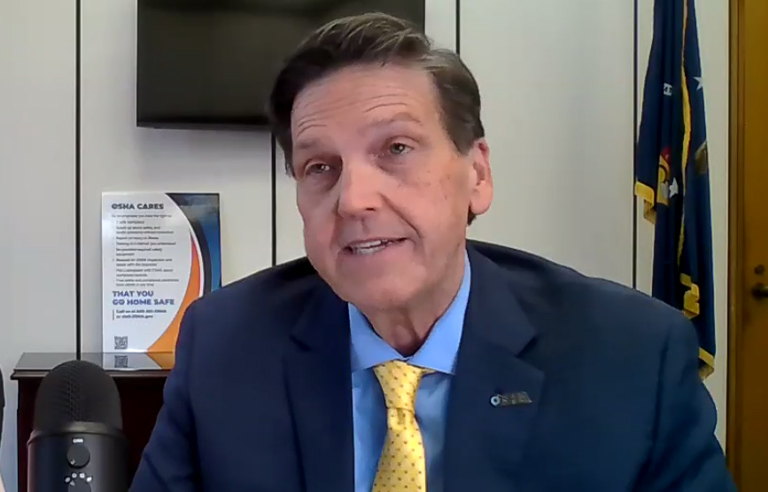
Speaking during a virtual meeting on March 23, Keeling highlighted the “OSHA Cares” initiative and the Safety Champions Program as examples of how the agency is trying to promote workplace safety through communication, guidance and practical solutions, in addition to regulations and citations.
According to him, OSHA is working to reclaim a more visible leadership position in the industry after what he described as a long period of reduced influence in that area.
“OSHA has kind of taken a step back, I think, over the last 15 to 20 years when it comes to the leadership position in the industry,” Keeling said during the meeting.
He stressed that enforcement, while still important, should not be the only tool available to the agency in addressing workplace hazards.
“We don’t have to have a regulation to make things better,” he said. “We don’t have to give a citation to make things better. When it’s appropriate, we’ll certainly do that.
“We want to be in the abatement business. We want to be in the solutions business. We don’t necessarily want to only be in the enforcement business. We want to fix the issue, and that includes coming at problems or coming at issues from many different directions, not just one.”
Keeling said the Safety Champions Program is intended to create a pathway for organisations, particularly small and medium-sized employers, to engage with OSHA’s Voluntary Protection Programs. He noted that many employers may be interested in stronger safety systems but lack the personnel, time or resources needed to commit immediately to the full VPP framework.
By offering a more accessible entry point, the programme is expected to help employers gradually strengthen their internal safety culture while building closer ties with OSHA’s broader compliance and prevention efforts.
The “OSHA Cares” initiative, Keeling said, is broader in scope and focused on improving communication and coordination among regulators, employers and workers. He described it as an effort to modernise how the agency shares information and supports safer workplaces.
Part of that effort includes making OSHA’s public-facing materials easier for workers to understand. Keeling said the recent update to the agency’s poster informing workers of their rights under the Occupational Safety and Health Act of 1970 was driven in part by feedback from OSHA investigators, who argued that the old version was overly dense and difficult to use.
“They said, ‘Look, the posters, they’re overburdened. They’re hard to read. They read like a law book. Can we make something simpler?’” he said.
The updated poster now includes a QR code, which Keeling said reflects an effort to communicate with workers in a more practical and modern way. Rather than relying only on lengthy printed text, the code allows employees to quickly access additional information on their phones.
He said the change was meant to meet workers where they are and adapt to the way people now consume information.
“Very few employees don’t have cellphones,” Keeling said. “We need to communicate in a way that’s a little more modern, a little more up to date.”
The administrator added that OSHA’s recent initiatives are already attracting attention beyond the federal agency itself. According to him, 12 State Plans have expressed interest in creating their own versions of the programmes, suggesting that the compliance assistance model may gain wider adoption across state-level occupational safety systems.
Keeling also used the meeting to address staffing at the agency, saying OSHA is actively hiring as it works to strengthen its workforce. He said the agency has received more than 1,000 applications for its current 108 open positions, an indication of strong interest despite the challenges facing the organisation.
He added that a second round of job postings would soon be released for positions requiring more technical expertise, including safety engineers and industrial hygienists, roles that are critical to inspections, hazard analysis and workplace safety oversight.
The hiring push comes against the backdrop of declining staffing levels within OSHA’s federal inspector corps. A report released in January by the Department of Labor’s Office of Inspector General showed that the number of federal inspectors fell to 736 as of June 2025, down from 846 in February 2024.
That decline has raised concerns about the agency’s capacity to carry out inspections and enforcement at a time when workplace safety remains a pressing issue across multiple sectors.
Keeling’s remarks suggest OSHA is attempting to respond to those pressures not only by rebuilding staffing levels, but also by broadening the tools it uses to influence workplace safety outcomes. By placing greater emphasis on abatement, communication and employer engagement, the agency appears to be positioning itself as both an enforcement body and a more proactive partner in accident prevention.
The two initiatives, along with the agency’s ongoing recruitment efforts, reflect a broader attempt to modernise OSHA’s approach and reassert its relevance in shaping workplace safety standards in the years ahead.